Showing posts with label reading. Show all posts

Tuesday, 23 June 2015

Using music to support early readers

I love picture books that feature rhyme, rhythm and song and come with backing CDs.  I find them highly engaging and wonderful for young emergent readers, as they encourage the children to join in with the reading and singing of the lyrics, or words in the picture book.

I recently shared some favourite titles from Craig Smith that come with backing CDs.  You can read that blog post here or by clicking on the image below.


Since then, I have found a couple of other new titles that are totally engaging - you can't help but join in with the reading/singing!

"She'll be Coming Round the Mountain"

Listen to a segment of the song here.  Scholastic provides free resources to support this text, including a cloze activity and teaching notes.  The lyrics are sung by The Topp Twins from New Zealand and this title is the latest in a series that includes "There's a Hole in My Bucket" (song teaser) and "Do Your Ears Hang Low?"  (song teaser).


"Itsy Bitsy Teenie Weenie Yellow Polka-Dot Bikini"

This picture book is just gorgeous.  Kerry Argent has captured the hippo's emotions so perfectly in the gorgeous illustrations and  Deborah Mailman sings the lyrics in the accompanying CD.  Have a listen to the song teaser here.

Jennifer from Stories and Songs in Second, recently blogged about using songs to build strong readers and movement and reading on the Adventures in Literacy Land blog.  Bex also blogged about using music to teach reading in another blog post for Adventures in Literacy Land.  Those blog posts are well worth the read!

I hope some of the titles shared today help to build up your collection :)

Have a great week!

Thursday, 15 May 2014

Elephant ideas

Hi friends

I need your help!!!  Please share ideas/strategies/resources/links for teaching about elephants in the comments section.

I am putting together a blog post for my fellow Aussie teachers around the topic of elephants, for Australia's National Simultaneous Storytime Day on 21 May (next week!!!).  For more information about the event, check out:  https://www.alia.org.au/nss 

I will be putting together some freebie resources to support my colleagues and a blog post with links etc.  My focus will be on supporting students/teachers in the middle years and probably around some of the socially critical issues surrounding elephants etc.

There are so many great ideas already shared by the author, illustrator, publisher and the Australian Library and Information Association.  Many of these are for the early years.

I don't know how to host a blog  linky, so please, if you have any great ideas/resources/links for teaching about elephants, or for this particular book, "Too Many Elephants in This House", please leave a comment in the comments section at the bottom of this post...

I really would appreciate your help in sharing ideas, as I would love my colleagues (after the National Testing this week) to have a fun, romping good time with their students that encourages and inspires reading :)

Can anyone think of any companion texts that might be suitable???  

All ideas would be greatly appreciated :)

Many thanks!
Kylie

Wednesday, 5 March 2014

Picture books inspiring children to love reading...and a bit of a controversy!

I read a delightful post on the Sprout's Bookshelf blog about "Amadi's Snowman".  You can read that post by clicking on the image below.


When I was reading that post, I made a connection to a newly published Australian picture book which arrived today, "The Bush Book Club" by Margaret Wild, illustrated by Ben Wood (published March 2014, so hot off the press!!!)  You can read more about the book here.  This is a delightful story about a reluctant reader, Bilby. Everyone is in The Bush Book Club except Bilby as he cannot see the purpose of reading.  He finds that books can be useful for building towers and mazes, but eventually discovers that books are also full of adventures.  This is a wonderful title for exploring Australian animals and environments, inspiring children to read and for studying rhyming words and verbs...it is such a delightful read!!!  Check out Ben Wood's blog as he shares how he went about illustrating the book here.

This also reminds me of another book for students who aren't avid readers of printed text, "It's a Book" by Lane Smith.  You can view the book trailer here.  It wasn't until I was drafting this blog post that I realised there had been controversy about this book using the technical term for a male donkey - jackass.  You can read some positive reviews here and posts about the "controversy" here and here.  You'll find a balanced review here. If you scroll down at this link, you can listen to a podcast by the author, Lane Smith. What I love about this podcast is that Lane mentions that he has "never had a kid take offence at anything", maybe it's the adults who read more into it? 

Personally, I find the fact there has been a "controversy" a bit ironic as I don't understand why people would be upset about the technical term for a male donkey being used in a book and seriously folks, I think there are far worse words that children hear on a daily basis nowadays in real life and through the media.  I have found students I have shared this book with haven't even noticed yet alone reacted to the word "jackass" as anything offensive at all.

What do you think?  Please leave a comment as I am open to other points of view...Also, do you know of any other titles that encourage children to read?

Have a terrific week :)


Friday, 15 November 2013

From "Rain Dance" to "Flood"

My previous post introduced the book, "Downpour".  You can read that post in my November blog post archive (right hand side of the blog - scroll down).

Our Summer storms are continuing in Queensland and there are two other picture books I am really enjoying.  The first is called, "Rain Dance" by Cathy Applegate and Dee Huxley (2000).  Set in the Australian outback, this is a beautiful picture book that brings to life the importance of rain to outback communities and the impact of drought.  You can almost smell and feel the rain as it hits the parched earth in the outback.  Dee Huxley's illustrations capture the terrain and colours of the outback so well.  The author's text provides a visual image to support the illustrations (e.g. "Beyond our desolate farm I can see the horizon where a few dark clouds cruelly taunt us with promises of rain".)  This would be a great mentor text for exploring descriptive and figurative language.

Teaching notes for teaching visual literacy using "Rain Dance" and other texts are available in the publication on the right.  A free download of the contents page that shows the picture books examined is available by clicking on that image and then the link to see sample pages.  There is a chapter in the book on the right on "In Flanders Fields" (by Norman Jorgenson and Brian Harrison-Lever) which is set in World War 1.

http://www.hbe.com.au/visual-literacy-through-picture-storybooks-engaging-middle-years-students-in-literature.html
 A companion text for "Rain Dance" is an Australian indigenous picture book, "Big Rain Coming" by Katrina Germein and one of my favourite indigenous illustrators, Bronwyn Bancroft.  You can view a youtube reading of this title here or download teaching ideas here.  This story is set in Katherine in the Northern Territory of Australia when people were experiencing severe drought and the anticipation of rain. Other teaching notes are available here.  
 These Australian indigenous titles about the importance of rain and the anticipation of rain could be compared and contrasted to picture books from other cultures with a similar theme, for example, "Sing Down the Rain" (1977) which is a poem about the annual Tohono O'odham saguaro harvest and rain-making ceremony.  More information about this cultural ceremony can be read via the Southwest Cross-Cultural Wisdom Circle page.  A choral reading script for this text is available here. 

It would be interesting to compare and contrast the animals mentioned in "Rain Dance" and also in "Sing Down the Rain" as the latter mentions ciquadas, however in Australia we have cicadas - I am wondering if they are the same thing?  Both texts also mention events and characters specific to the different cultures and contexts.  
http://www.candlewick.com/cat.asp?mode=book&isbn=0763653136

Another terrific picture book I have discovered recently is "The Rain Train" by Elena de Roo and Brian Lovelock (2010).  This is a fantastic picture book for exploring onomatopoeia.  You can almost hear and feel the rain as you read this picture book that tells the story of a train ride when the rain is pouring down.  You can almost feel the drizzle and chill through the illustrations.  Both the author and illustrator live in New Zealand.
 
Sometimes people live through droughts, wishing for rain and sometimes people experience too much rain and flooding.  In the past two years, people in South-East Queensland have experienced flash flooding and the devastation of flood waters. 

Two picture books that contrast representations of the experience of the Brisbane floods in January 2011 are Jackie French's "Flood" (illustrated by Bruce Whatley) and "Alex and the Watermelon Boat" by Chris McKimmie.  Both represent the events in different ways.  Figurative language could be explored using "Flood".  Caution needs to be taken, however, when sharing these picture books with students from the communities affected, as it may actually foster memories of loss and grief, so teacher judgement (as always) would need to be exercised.  Jackie French discusses "Flood" and how to handle some of these concerns here including students' positive reactions to the picture book ,which represents communities pulling together, survival and heroism.  The illustrations certainly bring back memories of the drench, the mud and the generosity of the thousands of volunteers (the "Mud Army").

From a critical literacy stance, I think it is far more powerful to compare and contrast how authors and illustrators represent the same event in different ways, through multiple texts, rather than just focusing on the study of representation of a single text.
 

Free teacher notes for "Flood" are available here through Scholastic or here through the Primary English Teaching Association Australia (which is an excellent organisation to be a member of if you aren't already - and no, they didn't pay me to say that!).   You can also view a youtube reading of "Flood" here.   


Free teaching notes for "Alex and the Watermelon Boat" are available here and teacher reviews are available here.
Please leave a comment if you know of any other texts that could be included in this text set, or if you have used any of the books mentioned in this blog post.

Now...next weekend is another huge giveaway of freebies from my friends who participated in the Super Sleuths blog hop last month...mark this in your diaries...my clip art has come and I am so excited about using it...so next weekend...don't miss "The Gift of Reading Blog Hop."

Many thanks


Thursday, 14 November 2013

Poppies and downpours

I am revisiting this post so I can share it through the Storybook Sunday linky at Paula's Place.  

Summer is well underway in Queensland and with that afternoon and early evening storms.  Remembrance Day is honoured on 11 November (during Summer) in Australia and it is when we remember those who lost their lives in war to protect us. As such, my post today involves poppies, the symbol of Remembrance Day for our ANZACs and fallen soldiers and also rain, as we have so many storms during Summer, which is great to ease the heat.

By now, if you have been following me, you know I love text sets with companion texts that help students develop intertextuality through text-to-text connections, as the students in my research project told me these were harder connections to make than text-to-self connections.

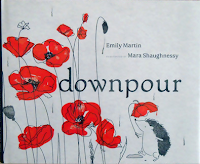
My first text to feature is called "Downpour" by Emily Martin (2013).  I love the review of the picture book that you can find here on the Design of the Picture Book blog.  I just love poppies, but I also love the illustrations by Mara Shaughnessy in this picture book .  (28.11.13 - I am thrilled to say I just received an email from Mara as Emily had read my blog!!! I am so thrilled as my blog is only relatively new...check at Mara's blog here where she writes about "Downpour".  Hearing from Mara has totally made my day!).

This would be a great text for exploring visual literacy and the use of colour, with simple black and white drawings which feature red.  You can view the book trailer by clicking on the cover of the book below and scrolling down.  The book is written in a poetic style and could also be used to study the use of rhyme and prose.

http://designofthepicturebook.com/2013/08/19/downpour/

A great companion text for critical visual literacy would be "Earl the Squirrel" by Don Freeman (2005).  Don Freeman is the well-known author of the much loved "Corduroy" series and similar styles of illustration are used in both "Downpour" and "Earl the Squirrel", so they could be compared and contrasted - the use of black outlines and the red colour through the pages to add emphasis - very exciting visual critical analysis work :) 

One of my favourite websites is Teaching Children Philosophy.  This website contains book modules with lesson ideas and philosophical prompts to encourage critical reflection, higher order thinking and philosophical inquiry using picture books.  Click on the image below to view the lesson ideas using "Earl the Squirrel" and some images from the book.

http://www.teachingchildrenphilosophy.org/wiki/Earl_the_squirrel


Another mentor text that could be used in a similar way to examine visual literacy and the use of black and white line drawings with the impact of red, is "Little Red Hood" by Marjolaine Leray (2011).  You can read reviews of the book and view one of the illustrations on the publisher's website.  I think the simplicity and impressionistic style of the illustrations add power to this simple innovation on the original story.  In this version, the wolf is still big and viscious looking, but actually quite dumb. Little Red questions his hygeine and uses her initiative to trick him. With very little written text, the power is in the illustrations, so it is a great mentor text for analysing visual literacy.  You can read a further review of this treasure at the 32 pages A Passion for Picture Books blog. 

http://www.phoenixyardbooks.com/view_book.php?id=12   


In contrast to the simple black and white pencil drawings with the red featuring promenance in making meaning in the text, "The Black Book of Colors" by Menena Cottin and Rosana Faria (2010) uses black as the feature colour, with black pages, white text and embossed black illustrations (with braille above the white text).  It features the braille alphabet on the end pages.  This is a really innovative approach to a picture book, because even though the text talks about what colours may taste and feel like, the whole picture book is printed on black paper.  The picture book was actually written to convey the experience of a person who can only see through the senses.  The text is translated into braille so the sighted reader can begin to experience what it might be like to read and "see" by touch.

Free teaching notes are available from Walker Books. 

These four picture books used together could frame up a really dynamic exploration of visual literacy and the way illustrations add meaning to text.

Click on the link at the top of the page to hop on over to Paula's blog to check out the other wonderful picture books that have been shared in her Storybook Sunday linky :)