Thursday, 14 November 2013

Poppies and downpours

I am revisiting this post so I can share it through the Storybook Sunday linky at Paula's Place.  

Summer is well underway in Queensland and with that afternoon and early evening storms.  Remembrance Day is honoured on 11 November (during Summer) in Australia and it is when we remember those who lost their lives in war to protect us. As such, my post today involves poppies, the symbol of Remembrance Day for our ANZACs and fallen soldiers and also rain, as we have so many storms during Summer, which is great to ease the heat.

By now, if you have been following me, you know I love text sets with companion texts that help students develop intertextuality through text-to-text connections, as the students in my research project told me these were harder connections to make than text-to-self connections.

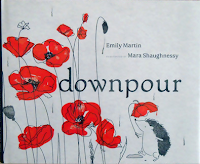
My first text to feature is called "Downpour" by Emily Martin (2013).  I love the review of the picture book that you can find here on the Design of the Picture Book blog.  I just love poppies, but I also love the illustrations by Mara Shaughnessy in this picture book .  (28.11.13 - I am thrilled to say I just received an email from Mara as Emily had read my blog!!! I am so thrilled as my blog is only relatively new...check at Mara's blog here where she writes about "Downpour".  Hearing from Mara has totally made my day!).

This would be a great text for exploring visual literacy and the use of colour, with simple black and white drawings which feature red.  You can view the book trailer by clicking on the cover of the book below and scrolling down.  The book is written in a poetic style and could also be used to study the use of rhyme and prose.
http://designofthepicturebook.com/2013/08/19/downpour/

A great companion text for critical visual literacy would be "Earl the Squirrel" by Don Freeman (2005).  Don Freeman is the well-known author of the much loved "Corduroy" series and similar styles of illustration are used in both "Downpour" and "Earl the Squirrel", so they could be compared and contrasted - the use of black outlines and the red colour through the pages to add emphasis - very exciting visual critical analysis work :) 

One of my favourite websites is Teaching Children Philosophy.  This website contains book modules with lesson ideas and philosophical prompts to encourage critical reflection, higher order thinking and philosophical inquiry using picture books.  Click on the image below to view the lesson ideas using "Earl the Squirrel" and some images from the book.

http://www.teachingchildrenphilosophy.org/wiki/Earl_the_squirrel


Another mentor text that could be used in a similar way to examine visual literacy and the use of black and white line drawings with the impact of red, is "Little Red Hood" by Marjolaine Leray (2011).  You can read reviews of the book and view one of the illustrations on the publisher's website.  I think the simplicity and impressionistic style of the illustrations add power to this simple innovation on the original story.  In this version, the wolf is still big and viscious looking, but actually quite dumb. Little Red questions his hygeine and uses her initiative to trick him. With very little written text, the power is in the illustrations, so it is a great mentor text for analysing visual literacy.  You can read a further review of this treasure at the 32 pages A Passion for Picture Books blog. 

http://www.phoenixyardbooks.com/view_book.php?id=12   


In contrast to the simple black and white pencil drawings with the red featuring promenance in making meaning in the text, "The Black Book of Colors" by Menena Cottin and Rosana Faria (2010) uses black as the feature colour, with black pages, white text and embossed black illustrations (with braille above the white text).  It features the braille alphabet on the end pages.  This is a really innovative approach to a picture book, because even though the text talks about what colours may taste and feel like, the whole picture book is printed on black paper.  The picture book was actually written to convey the experience of a person who can only see through the senses.  The text is translated into braille so the sighted reader can begin to experience what it might be like to read and "see" by touch.

Free teaching notes are available from Walker Books. 

These four picture books used together could frame up a really dynamic exploration of visual literacy and the way illustrations add meaning to text.

Click on the link at the top of the page to hop on over to Paula's blog to check out the other wonderful picture books that have been shared in her Storybook Sunday linky :)


Monday, 4 November 2013

Critical Literacy with "The Three Bears (Sort Of)" by Yvonne Morrison

This has to be one of my favourite new picture books and I thank Margaret for letting me know about it.  Click on the cover of the book to read a review.  This is an excellent picture book for critical literacy.  It also has a lovely twist in the ending, so would make a terrific mentor text for writing.

The narrator begins reading the story of "The Three Bears" and is constantly interrupted with questions that challenge the accuracy of the traditional tale.  I created a resource to support critical reflection on the text.  You can preview it by clicking on the image on the right.


http://www.scholastic.co.nz/publishing/assets/pdf/NewFor/Three%20Bears%20(sort%20of).pdf  http://www.teacherspayteachers.com/Product/Critical-Literacy-The-Three-Bears-Sort-Of-867053

 This title would work well as a companion text with "Interrupting Chicken" or "Again".

http://www.scholastic.com/teachers/book/interrupting-chicken  http://authors.simonandschuster.com/Emily-Gravett/35393029

Other texts that could work in well with a critical approach to fairy tales, include "No Bears" and "Bad Boys".  Free teacher notes and activities are available from the publisher's website for "No Bears" - just click on the image below.

http://www.walkerbooks.com.au/Books/No-Bears-9781921529924   

 Both "The Three Bears (Sort Of)" and "No Bears" are new releases for 2013.  You can read a review of "No Bears" here.  It's a terrific picture book for exploring how illustrations add meaning to a text and intertextuality with the various fairytale characters  depicted in the illustrations throughout the story.  It would also be a useful text for teaching inferring - who really did save the princess?

"Bad Boys" is also a good text for exploring intertextuality and also for teaching idioms and alliteration.  I like to use text sets as it helps model how to make "text-to-text connections".

Have a terrific week everyone - and don't forget the blog hop this weekend. 

Click on the image below during 8-10 November to pick up some great freebies during the blog hop!

http://hangingoutinfirst.blogspot.com.au/


Saturday, 26 October 2013

A focus on the "ability" in "disability"


Hi everyone

I had the great pleasure recently of presenting at a conference of Special Educators about the teaching of reading.  Firstly, "hats off" to the teachers who work with students with "special needs" or I like to call it "additional needs" as I think all kids have "special needs".


There are a number of picture books that I just love for looking at individual differences and strengths.  Check out my "Cutlery & Conformity" blog post for ideas that could be used for all students about inclusivity and individual identity. 

The picture books in this post are specifically around disability, but I like to focus on the "ability" not the "dis".  A resource I made for this is "Don't 'diss' my Ability" based on the picture book, "Susan Laughs" by Jeanne Willis. Donna Wakefiled reads the story on youtube here.   Check out my resource by clicking on the cover image below (left).


One of my all time favourite picture books for this is Australian.  It is written and illustrated by Melanie and Maggie Prewett who are descended from the Ngarluma people of the Pilbara region of Western Australia.  They are a mother and daughter team and Melanie is the mother of Jack, the central character in the picture book, "Two Mates". 
 
 "Two Mates" is the true story of two boys and their special mateship growing up in Broome in far north Western Australia.  They fish for salmon, hunt for barni, dress up as superheroes, ride the quad bike, go fishing and prove that friendship has no boundaries...     I am not going to spoil the ending for you (although I just realised that the teacher notes give it away), but it has a real twist and is an awesome mentor text for writing, even if you didn't use it within the context of "ability" and "disability".  It is one of my all time favourites and I am very thankful to Shelly for introducing it to me last year.

You can purchase the book and find out more about it through the publisher, Magabala books. They even provide free teacher notes. While you are there you might like to check out other great titles written and illustrated by indigenous authors and illustrators.

Other picture books I love using around this topic include:

"Keep Your Ear on the Ball" by Genevieve Petrillo (Free teacher notes here)

"Looking After Louis" by Lesley Ely.  A critical review of "Looking After Louis" questions how disability is represented in the text and the affect it may have on young readers.  This reveiw argues that the illustrations and text contradict each other and may produce a negative representation of disability.  I actually really enjoyed the book for the teamwork, inclusivity and understanding portrayed, but it is always good to critically reflect on issues such as these and to consider other viewpoints.

Desiree Pointer Mace reads "Looking After Louis" on youtube.

"Just Because" by Jacqueline Wilson.  This book is based on the author's two children, Toby and Clemmie. Visit the author's website here to find out more.

"How Katie Got a Voice (and a very cool new nickname)" by Patricia L. Mervine.  You can view a youtube clip of the story here or visit the author's website to find out more, including viewing a video about disability ettiquette.


Check out my pinterest board on Social Emotional and Behaviour or my board on picture books featuring characters with Special Needs for further ideas.

Also check out my friend Tess's blog on Autism - you will find heaps of information here :)


Thanks again to the wonderful Iva from etsy who does all of my custom-made clip art for me.  I just love her work.  You can find Iva on etsy by following this link to her etsy store - nahhan73.


Thursday, 24 October 2013

Super Sleuth Blog Stop #24


Well Super Sleuth, you're almost to the end, but you haven't finished yet.  Read on to learn a bit about the Here, Hidden, Head, and Heart reading comprehension strategy.


Here, Hidden, Head, and Heart

The Here, Hidden, Head and Heart (4Hs) strategy is an adaption of Question Answer Relationships - QAR (Taffy Raphael) and Three Level Guides.  The questions support close reading of texts and multiple re-readings. I have found the language of the 4Hs much easier to use than QAR with students, as they don’t struggle so much about the wording or “QAR categories”.  It’s pretty simple - Is the answer “here” (in the text), “hidden” (think and search), “in my head” (my own opinion or prior knowledge) or “in my heart” (how I feel about the issue, topic or text)?  References to other work around this are included in my freebie.
 

 Details about My Freebie 
My freebie includes 20 pages, with posters, bookmarks and detective magnifying glasses for the 4H strategy that may be used in small group reading activities.  I have also included questions from "Private I. Guana" by Nina Laden that can be used to demonstrate the 4H strategy and a graphic organiser to support close reading of "Tough Cookie" by David Wisniewski.

To access my freebie, you will need to click the case file below.  The file is housed in my Teachers' Pay Teachers (TPT) Store.  It is free during this weekend, but after the hop, it will be a paid item.  I hope you enjoy using it with your students this year and that the tips I've shared are helpful to you in your classroom reading instruction.  

Now that you've learned a little about teaching the 4H strategy, you're ready for my clue.  On your form, you can record this letter next to Ripper Resources...

Red Letter T

I live in Australia and am fairly new to Blogland, but I have lots of information to share.  In the coming weeks, I'll be participating in a Thanksgiving Hop too, so drop back by for more details on that. You can also catch my news, tips, product information, and special events by following my blog on Bloglovin.
To do so, just click on the button below to sign up.  

Follow on Bloglovin


Only four more stops to go.  You're almost to the end, so don't give up yet!  Jump on over to your next stop.  Stacy at Teacher's Take-Out has great things for you.  Just click on the next stop button below to jump to her blog.  Good luck!