Showing posts with label NAPLAN. Show all posts

Sunday, 3 May 2015

NAPLAN - higher order thinking narrative preparation

NAPLAN is the National Assessment Program in Literacy and Numeracy in Australia and I am happy to introduce my latest resource for comprehending and composing narratives (Years 3 to 7).  52 pages of higher order thinking reading comprehension and composing activities are included, based on two narrative texts that have morals or messages.  

I have seriously discounted the price of this new resource, as a way of sharing my work with you and also to support rigorous, explicit teaching, instead of the mindless practising of past test papers.

The resource links the U.S. research on close reading with the Australian research on the Four Resources model (Freebody & Luke, 1990), as well as accountable talk prompts and philosophical inquiry discussion starters.  You can find out more about the links between close reading and the Four Resources model through my previous blog posts here.
You can find out more about my new narrative resource for Years 3 to 7 (pictured above) here or by clicking on the product overview image above.

This is a summary of the contents of the Year 3 to 7 narrative resource, although it was difficult to summarise all 52 pages (I couldn't fit all the pages in the preview overview either):


•  “The Best Teacher” (author unknown)
•  “Nails in the Fence” (author unknown)
•  Higher order thinking reading comprehension activities including graphic organisers and reading response activities, with plenty of inferring and using text evidence to justify responses
•  The Four Resource Model prompts and close reading
•  Making connections, character traits, summarising, problem/solution structure
•  Word work (vocabulary)
•  Writing scaffold for a narrative (fable) - "Show, Don't Tell" prompts, including suggestions for writing leads, themes and character conflicts
•  Accountable talk prompts
•  Book talk discussion prompts

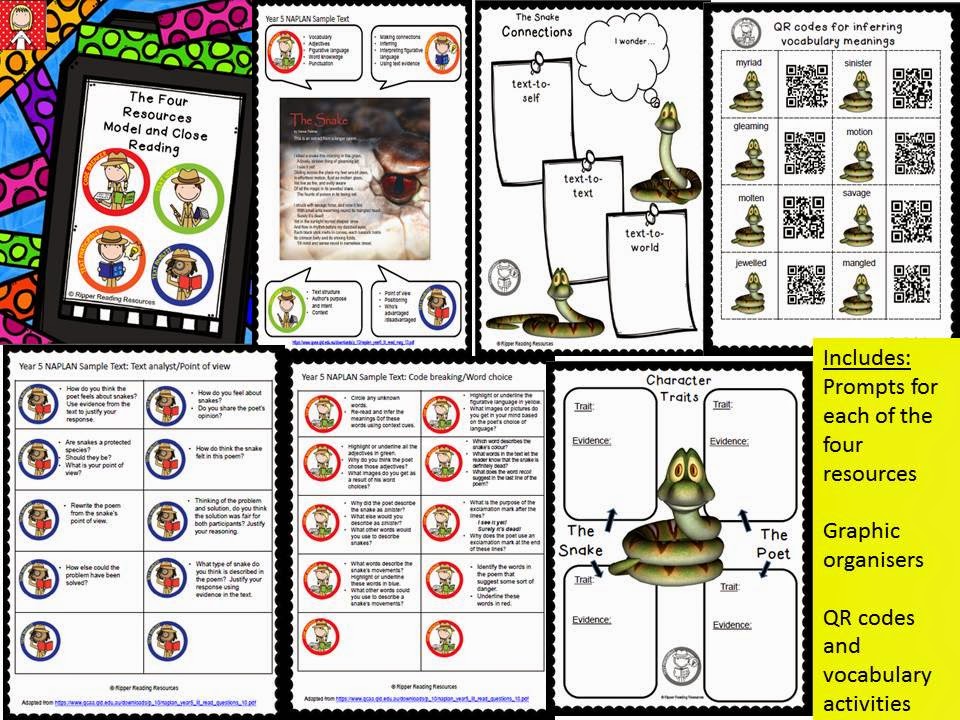
There are other units in this series too that I have recently produced.  There is one for Year 5 using the poem "The Snake" from a previous Year 5 NAPLAN reading magazine (reproduced with permission) which focuses on the comprehension of figurative language which is a priority with NAPLAN narrative preparation:
It is also discounted for a limited time.  You can find out more about this resource here.

There is also a poetry unit that develops students' sensory approaches to writing, to introduce the idea of writing using the senses (which underpins "Show, Don't Tell).  This resource again features figurative language and is based on two original poems by Angela Yardy (reproduced with permission).  I would probably use this narrative resource with Years 3 to 5.  You can find out more about this resource here or by clicking on the images below.
This NAPLAN season, why not try some higher order thinking NAPLAN preparation for narrative texts? Even though we don't know what the genre is going to be this year, in a balanced literacy program, we explicitly teach a range of genres, so these resources can be used well beyond the NAPLAN season :)

The seaside poetry resource also focuses on figurative language and the link between close reading and the Four Resources Model.  It is also discounted for a limited time.

These resources are not based on 'teaching to the test', they are based on rigorous pedagogies, higher order thinking and explicit teaching (not 'skill and drill', or what I often call, 'skill and kill'!).

All the best to my teaching colleagues in Australia for the upcoming NAPLAN season.  I hope you and your students have some fun and authentic, quality learning with these new resources :)

Sunday, 5 April 2015

Close reading and the Four Resources Model for NAPLAN preparation

Happy Easter everyone!  Back in January I blogged about my work linking the Australian research on the Four Resources Model with the U.S. research around close reading.  You can read those blog posts here and here.


Today I would like to share with you another resource that links the Four Resources Model and close reading, but is specifically designed for NAPLAN preparation (NAPLAN is Australia's National Testing in Literacy and Numeracy).   The focus text is a poem which comes from a previous Year 5 NAPLAN reading magazine and has been reproduced with permission.  

Instead of practising past tests, this resource provides prompts for each of the four resources, to support multiple re-readings of the text for different purposes and higher order thinking.  The resource also includes graphic organisers to scaffold students' thinking and QR codes for inferring vocabulary.  Other vocabulary and figurative language activities are also included.

You can find out more here or my clicking on the image above.

References:

Freebody, P. & Luke, A. (1990). Literacies programs: Debates and demands in cultural context. Prospect: Australian Journal of TESOL, 5(7), 7-16. 

Lehman, C., & Roberts, K. (2014). Falling in love with close reading: Lessons for analysing texts - and life. Portsmouth, NH.: Heinemann.

NAPLAN Year 5 Reading Magazine 2010 https://www.qcaa.qld.edu.au/downloads/p_10/naplan_year5_lit_read_mag_10.pdf

Saturday, 24 January 2015

Close reading and the Four Resources Model (con't)

Last week I posted about a new project I was working on, linking the U.S. research on close reading with the Australian research around the Four Resources Model (Freebody & Luke, 1990).

I created three resources to use with a school I was working with this week.  The first one is based on the picture book, "Blossom Possum - The Sky is Falling Down-Under" (see below):
This resource was designed for students in the early years (up to Year 3).
The second resource is based on two original poems by Angela Yardy - Seaside Senses and The Shell. 

Each resource includes purposeful reasons for the students to re-read the text and engage with it in different ways to deepen their comprehension.
Please click on the images above to find out more.

My third resource is based on figurative language, using a poem called "The Snake" from the NAPLAN (Australian National Testing) Year 5 magazine.  I am just waiting for copyright clearance on that one before I post it to TPT.  

Both of the resources based on poetry are quite challenging for students in Year 5 and above.

By linking close reading to the Four Resource Model prompts, students engage multiple times with the text for different purposes.  To me, this is much more rigorous NAPLAN preparation than practising past tests.

If you would like to win a free copy of one of these resources, please make sure you are following my blog.  You can do this for free by clicking on the "follow me by bloglovin' " button, or via email.  Please leave a comment below with your email address and which resource interests you the most.  I will choose 3 winners randomly over the next week.

A very big shout out to all the Australian teachers who follow my blog - enjoy your first week of the new school year, next week :)

Sunday, 18 January 2015

Close reading - bringing the U.S. and Australian research together

I am so excited about my latest project.  I have been dabbling at linking the U.S. research on close reading with the Australian research by Freebody and Luke (1990) on the Four Resources Model.  Find out more about the Four Resources Model here.

After reading, "Falling in Love with Close Reading" (Lehman & Roberts, 2014) these are the links I have made:
I am flying up north to work with a school this week around the teaching of reading.  I will be focusing on reciprocal teaching and you can read about my innovations on that in English and Mathematics here. 

My colleagues and I are also working with another couple of schools around improving their student data in reading, so I am very blessed that the poet Angela Yardy (click on her name to see her great website) has allowed me to use two of her works to develop a resource that focuses on close reading and figurative language.

In Australia, our national assessment program is NAPLAN and I wanted to be able to show the teachers that if, for example, figurative language was an area wanting in the data analysis, that close reading could be used, using the Four Resource Model as a lens, so that rather than drilling kids with past tests and practice tests, we can actually teach them explicitly in the areas where gaps have been identified for a cohort.

I will be sharing both resources I have created via TPT, so please make sure you are following me on TPT (Ripper Reading Resources) to be updated as new resources are posted.